


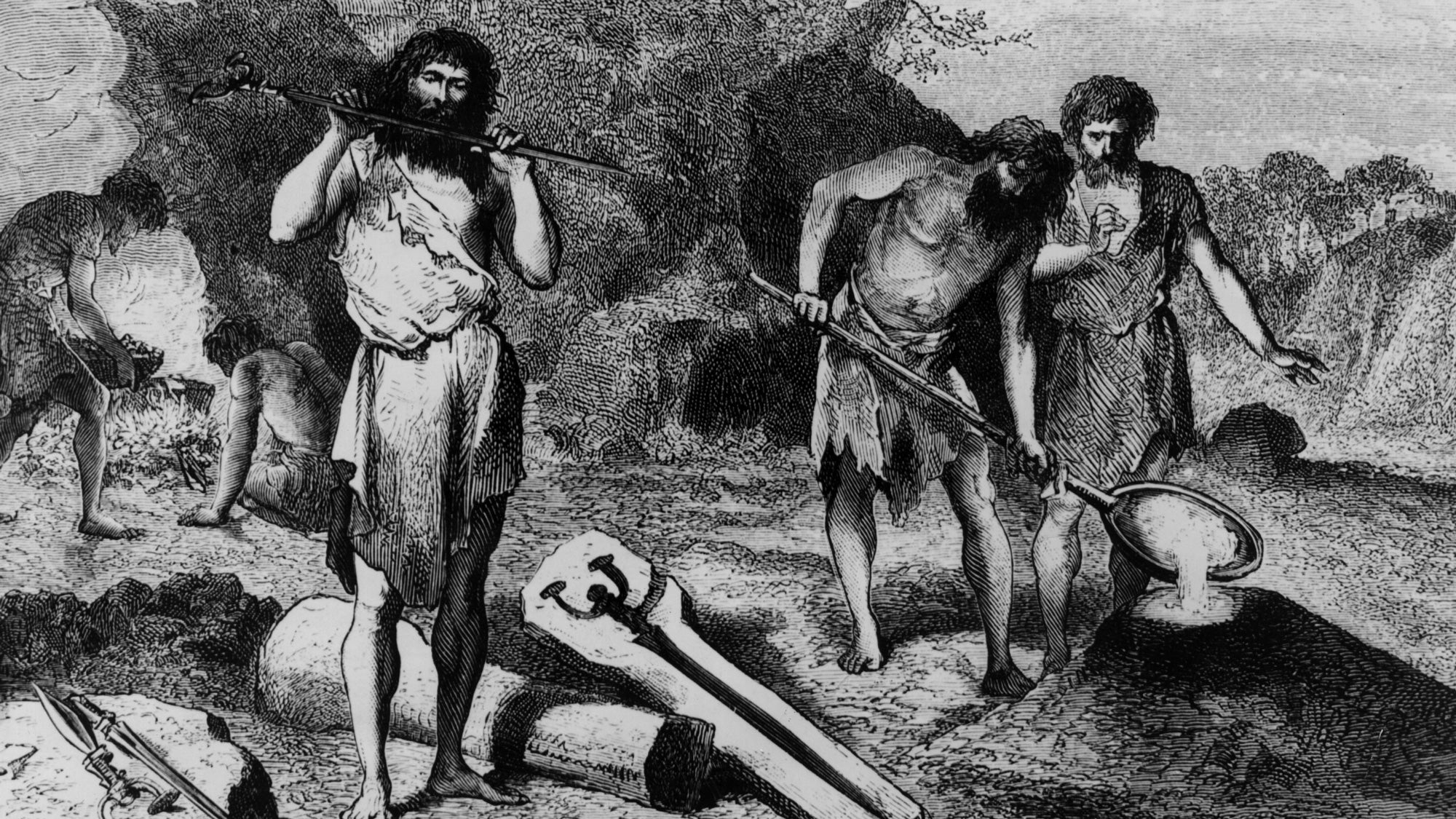
Bronze Age tools
Humans may have started smelting copper as early as 6,000 BC. Fertile crescenta region often called “the cradle of civilization” and a historic area of the Middle East where agriculture and the world’s first cities emerged.


A reconstruction drawing of a Bronze Age cottage interior at Grimspound. a late Bronze Age settlement located on Dartmoor in Devon, England. It was a set of 24 circles of cabins surrounded by a low stone wall.
Ancient Sumer It may have been the first civilization to begin adding tin to copper to make bronze. Bronze was harder and more durable than copper, making bronze a better metal for tools and weapons.
Archaeological evidence suggests that the transition from copper to bronze took place around 3300 BC. The invention of bronze put an end to the Stone Agethe prehistoric period dominated by the use of stone tools and weapons.
9 most badass weapons in all of history
Different human societies entered the Bronze Age at different times. Greek civilizations began working in bronze before 3000 BC, while the British Isles and China entered the world. Bronze Age much later, around 1900 BC and 1600 BC, respectively.
The Bronze Age was marked by the rise of states or kingdoms, large-scale societies united under a central government headed by a powerful ruler. Bronze Age states interacted with each other through trade, warfare, migration, and the spread of ideas. Important Bronze Age kingdoms included Sumer and Babylonia In Mesopotamia and Athens in Ancient Greece.
The Bronze Age ended around 1200 BC when humans began to forge an even stronger metal: iron.
Bronze Age Civilizations


A map of Europe in the Late Bronze Age, circa 1100 BC
Sommer: By the fourth millennium BCE, the Sumerians had established about a dozen city-states throughout ancient Mesopotamia, including Eridu and Uruk in what is now southern Iraq.
The Sumerians called themselves Sag-giga, those with black heads. They were among the first to use bronze. They were also the first to use dikes and canals for irrigation. The Sumerians invented cuneiform writing, one of the earliest forms of writing, and built large stepped pyramid temples called ziggurats.
The Sumerians celebrated art and literature. The 3,000-line poem “The Epic of Gilgamesh” follows the adventures of a Sumerian king as he battles a forest monster and searches for the secrets of eternal life.
Babylonia: Babylonia rose to prominence in the Bronze Age around 1900 BC, in present-day Iraq. Its capital, the city of Babylon, was first occupied by people known as the Amorites.
The Amorite king Hammurabi created one of the oldest and most comprehensive written legal codes in the world. THE Code of Hammurabi helped Babylon surpass the Sumerian city of Ur as the most powerful city in the region.
Assyria: Assyria was a major political and military power in ancient Mesopotamia. At its height, the Assyrian Empire stretched from modern-day Iraq in the east to Turkey in the west and Egypt in the south. The Assyrians frequently waged war against the pharaohs of Ancient Egypt and the Hittite Empire of Türkiye.
Assyria owes its name to its original capital, the ancient city of Ashur, located on the west bank of the Tigris River in modern-day Iraq.
Bronze Age China
In China, Bronze Age civilizations centered around the Yellow River during the the Shang dynasty (1600-1046 BC) and the Zhou dynasty (1046-256 BC). Chariots, weapons, and vessels were fashioned from bronze using piece casting, as opposed to the lost wax method used in other Bronze Age cultures. This meant that a model had to be made from the desired object and then covered with a clay mold. The clay mold was then cut into sections which were annealed to create a single mold.
Bronze Age Greece

Minoan civilization on the Greek island of Crete.
Greece became a major center of activity on the Mediterranean during the Bronze Age. The Bronze Age in Greece began with the Cycladic civilization, an early Bronze Age culture that appeared southeast of the Greek mainland on the Cyclades islands in the Aegean Sea around 3200 BC.
A few hundred years later, the Minoan civilization emerged on the island of Crete. The Minoans are considered the first advanced civilization in Europe.
The Minoans were traders who exported wood, olive oil, wine and dyes to neighboring Egypt. Syria, Cyprus and the Greek continent. They imported metals and other raw materials, including copper, tin, ivory and precious stones.
Around 1600 BC, the Mycenaean civilization developed on the Greek mainland and their culture flourished during the late Bronze Age. The main Mycenaean centers of power included Mycenae, Thebes, Sparta and Athens.
Many Greek myths are linked to Mycenae. In Greek mythology, the city of Mycenae was founded by Perseus, the Greek hero who beheaded Medusa. The Mycenaean king Agamemnon invaded Troy during the Trojan War from Homer’s “Iliad”, although there is no historical record of a Mycenaean king of that name.
Bronze Age collapse
The Bronze Age ended abruptly around 1200 BC in the Middle East, North Africa, and Mediterranean Europe. Historians don’t know for sure what caused the Bronze Age Collapse, but many believe the transition was sudden, violent, and culturally disruptive.
The major Bronze Age civilizations, including Mycenaean Greece, the Hittite Empire in Turkey, and ancient Egypt, fell in a short time. Ancient cities were abandoned, trade routes were lost, and literacy declined throughout the region.
Researchers believe a combination of natural disasters may have brought down several Bronze Age empires. Archaeological evidence suggests that a succession of severe droughts in the eastern Mediterranean region over a 150-year period, from 1250 to 1100 BC, likely played a significant role in the collapse. Earthquakes, famine, sociopolitical unrest, and invasions by nomadic tribes may also have played a role.
Sources
Drought led to collapse of civilizations, study finds; National geographic.
Mycenaean civilization; Encyclopedia of ancient history.
Shang and Zhou Dynasties: China’s Bronze Age; The encounter.
