


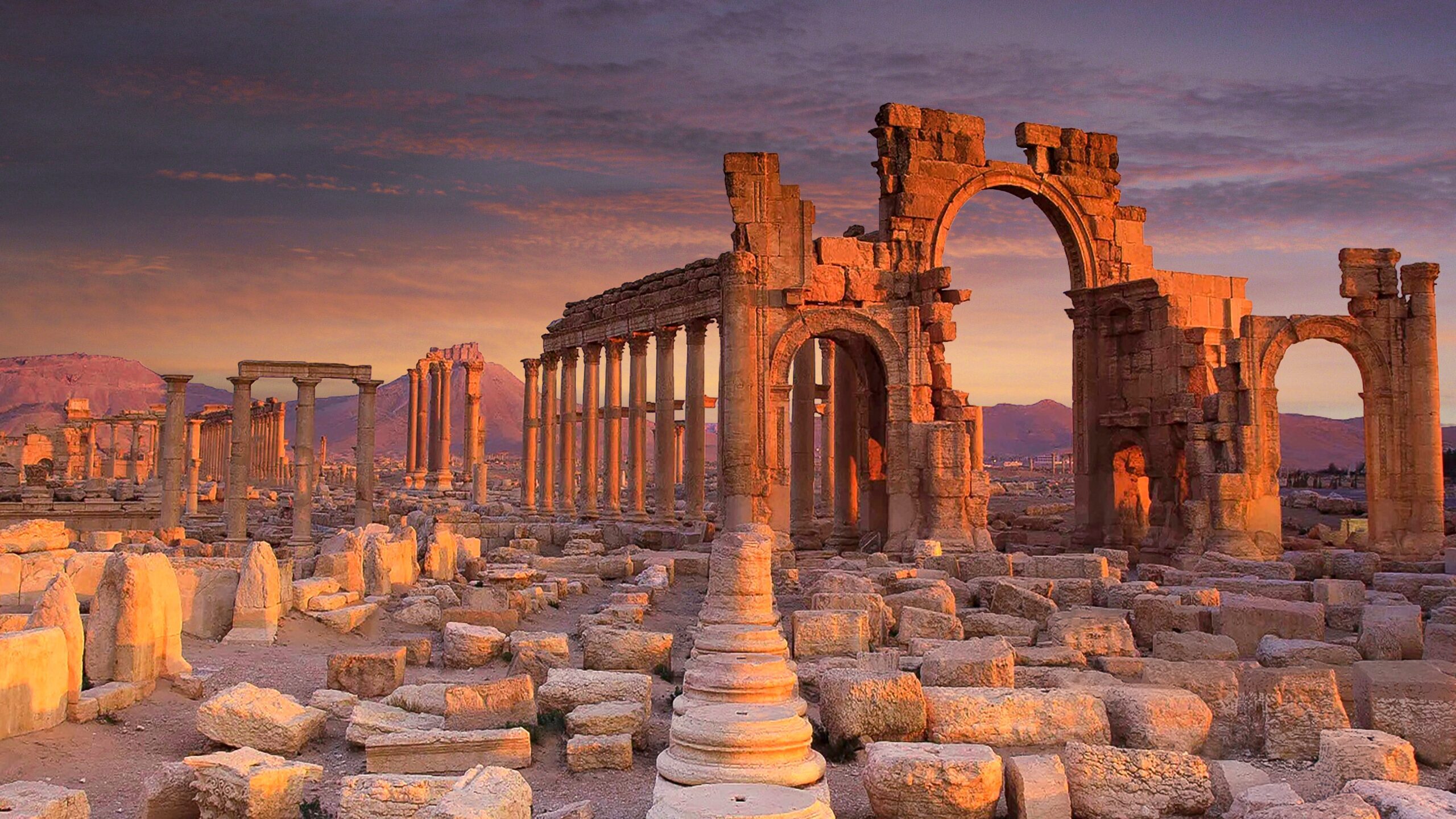
Ancient Syria
Today’s Syria, a country located in the Middle East on the Mediterranean Sea, is one of the oldest inhabited regions on the planet.
The oldest human remains discovered in Syria date back around 700,000 years. Archaeologists have discovered skeletons and bones of Neanderthals who lived in the area at that time.
Ebla, a Syrian city believed to have existed around 3,000 BC, is one of the oldest settlements excavated.
Throughout antiquity, Syria was occupied and ruled by several empires, including the Egyptians, Hittites, Sumerians, Mitanni, Assyrians, Babylonians, Canaanites, Phoenicians, Arameans, Amorites, the Persians, Greeks and Romans.
Ancient Syria was a region often mentioned in the Bible. In one well-known account, the apostle Paul cited the “road to Damascus” – the largest city in Syria – as the place where he saw visions that led to his death. Christian conversion.
With the fall of the Roman Empire, Syria became part of the Eastern Empire or Byzantine Empire.
In 637 AD, Muslim armies defeated the Byzantine Empire and took control of Syria. The Islamic religion quickly spread throughout the region and its various factions rose to power.
Damascus eventually became the capital of the Islamic world, but was replaced by Baghdad in Iraq around 750 AD. This change led to Syria’s economic decline, and over the next centuries the region became unstable and was ruled by various groups.
In 1516, the Ottoman Empire conquered Syria and remained in power until 1918. This period has been considered a relatively peaceful and stable period in Syria’s history.
The Sykes-Picot agreement
During First World WarFrench and British diplomats secretly agreed to divide the Ottoman Empire into zones, under the Sykes-Picot Agreement of 1916.
Under the Sykes-Picot Agreement, most Arab lands under the rule of the Ottoman Empire were divided into British or French spheres of influence at the end of the First World War.
British and Arab troops captured Damascus and Aleppo in 1918, and the French took control of present-day Syria and Lebanon in 1920. These arrangements ended about 400 years of Ottoman rule in the region.
French rule led to uprisings and revolts among the Syrian people. From 1925 to 1927, Syrians united against French occupation in what is now known as the Great Syrian Revolt.
In 1936, France and Syria negotiated an independence treaty, which allowed Syria to remain independent but gave France military and economic power.
During The Second World WarBritish and Free French troops occupied Syria, but soon after the war ended, Syria officially became an independent country in 1946.
Syria as an independent nation
The years immediately following Syria’s declared independence were marked by instability and repeated coups.
Syria joined Egypt and became the United Arab Republic in 1958, but the union split a few years later in 1961. The 1960s caused more military coups, revolts and riots.
In 1963, the Arab socialist Baath Party, active throughout the Middle East since the late 1940s, seized power in Syria in a coup known as the Baath Revolution.
In 1967, during the Six Day War, Israel seizes the Golan Heights, a rocky plateau located in southwest Syria. The conflict over this coveted area has lasted for years and still continues.
Hafez al-Assad
In 1970, Hafez al-Assad, the Syrian defense minister, overthrew Syria’s de facto ruler, Salah Jadid. He remained in power as president for 30 years, until his death in 2000.
Hafez al-Assad was part of the Islam Alawite, which is a minority Shiite sect. During his presidency, Hafez was credited with strengthening the Syrian army with Soviet assistance.
Syria and Egypt went to war with Israel in 1973. Shortly after this conflict, Syria also became involved in the civil war in Lebanon, where it has maintained a military presence ever since.
In 1982, the Muslim Brotherhood staged a rebellion against Assad’s regime in the city of Hama, and Assad responded by arresting, torturing, and executing political rebels. Estimates vary, but many experts believe the reprisals cost around 20,000 civilian lives.
The same year, Israel invaded Lebanon and attacked the Syrian army stationed there. But in 1983, Israel and Lebanon announced the end of hostility between the two countries.
Towards the end of his life, Hafez attempted to establish more peaceful relations with Israel and Iraq.
Bashar al-Assad
When Hafez al-Assad died in 2000, his son Bashar became president at age 34.
After Bashar came to power, the constitution was amended to reduce the minimum presidential age from 40 to 34.
A medical student, Bashar was not the first choice to succeed him. His older brother, Bassel, was next in line to take his father’s place, but he was killed in a car accident in 1994.
Early in his presidency, Bashar al-Assad released 600 political prisoners, and Syrians hoped their new leader would grant more freedoms and impose less oppression than his father.
However, in less than a year, Bashar resorted to threats and arrests to end his reform activism.
Syria and the “Axis of Evil”
In 2002, the United States accused Syria of acquiring weapons of mass destruction and placed the country on the list of so-called “axis of evil” countries. The Syrian government has also been accused of involvement in the assassination of Rafic Hariri, the Lebanese Prime Minister, in 2005.
After a few years of what appeared to be potential diplomacy between Assad and other countries, the United States renewed its sanctions on Syria in 2010, saying the regime supported terrorist groups.
Numerous human rights groups have reported that Assad regularly tortured, imprisoned and killed political opponents throughout his presidency. The revolts in Egypt and Tunisia, known as theArab Spring”, broke out in early 2011.
In March 2011, a group of teenagers and children were arrested and tortured for writing anti-government graffiti believed to be inspired by the Arab Spring rebellion.
Peaceful protests broke out in Syria after the graffiti incident and became widespread. Assad and the Syrian government responded by arresting and killing hundreds of protesters and their family members.
These events, combined with other circumstances, including an economic downturn, a severe drought, a lack of general freedoms, and a tense religious atmosphere, led to civil resistance and, ultimately, an uprising.
Syrian Civil War
By July 2011, rebels had formed the Free Syrian Army (FSA), and pockets of insurgency broke out. But in 2012, Syria was plunged into a full-blown civil war.
Estimates vary, but according to the Syrian Observatory for Human Rights, at least 321,000 people have been killed since the start of the war or are missing.
Hundreds of people were killed outside Damascus in 2013 in a chemical weapons attack. The United States said the attack was carried out by the Syrian government, but the regime blamed rebel forces.
What began as a war between the Assad government and Syrian rebels became more complicated as the battle progressed. New forces, including the Islamic State (ISIS), joined the fight against the Syrian regime.
In 2014, ISIS captured large areas of Iraq and Syria. Since then, U.S.-led forces have strategically bombed ISIS targets across the region.
The United States has declared its opposition to the Assad regime but has been reluctant to become deeply involved in the war. Russia and Iran have declared themselves allies of the Syrian government.
In 2015, Russia launched airstrikes against rebel targets in Syria for the first time. Syrian government forces took control of Aleppo in late 2016, ending more than four years of rebel rule in the city.
On April 7, 2017, the United States launched its first direct military action against Assad’s forces after accusing them of carrying out another chemical weapons attack against civilians.
Syrian refugees
The Syrian civil war has caused an international humanitarian crisis for the country’s civilians.
More than 11 million Syrians, about half the country’s population, were displaced from their homes as of April 2017, according to the nonprofit World Vision.
Many refugees have moved to neighboring countries such as Turkey, Lebanon, Jordan, Egypt and Iraq. Others have moved to areas within Syria itself.
Europe has also been an important haven for refugees, with Germany hosting the most. According to the Migration Policy Institute, 18,007 Syrian refugees resettled in the United States between October 1, 2011 and December 31, 2016.
Sources:
The CIA Global Factbook: Syria: the American Central Intelligence Agency.
Brief overview of the history of ancient pre-Hellenistic Syria: UCLA/Syrian Digital Cuneiform Library (SDLC).
The civil war in Syria explained from the start: Al Jazeera Media Network.
Syria Profile – Timeline: BBC News.
A guide to the history of recognition, diplomatic and consular relations of the United States, by country, since 1776: Syria: Office of the Historian, U.S. Department of State.
City of Massacre: Foreign policy.
SOHR coverage: Syrian Observatory for Human Rights.
Complete Executive Decree Text: Trump’s action limiting the entry of refugees into the United States: The New York Times.
Syrian refugees in the United States: Migration Policy Institute.
